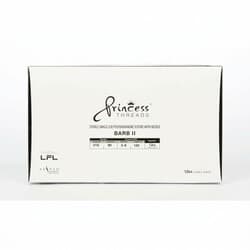
Presentation Developed by Croma laboratories, PDO Barb II 23G 90 mm threads represent an advanced solution for tissue remodeling. Thanks to their innovative design incorporating bidirectional barbs, these threads act like tiny hooks to reposition and firmly hold sagging tissues. Each box contains 12 ready-to-use threads. The use of Ultra Thin Wall needles ensures smooth insertion, minimizing tissue trauma.
Composition
& rheology Material: Fully bioabsorbable Polydioxanone (PDO). Thread type: Bidirectional barbed (Barb II). Needle gauge: 23G. Thread length: 90 mm. Packaging: Box of 12 threads.
Indications
This medical device is indicated for the treatment of moderate to severe skin laxity. It helps elevate tissues in the mid and lower face, redefine the jawline, correct cheek ptosis, and lift the neck or eyebrow area. It is also suitable for contouring and lifting various body areas requiring tightening.
Posology The insertion of PDO Barb II threads is performed into the subcutaneous tissue following local anesthesia of the targeted area. The number of threads required depends on the degree of ptosis and the treatment area.
The procedure, lasting an average of 15 to 40 minutes, requires no incisions, ensuring rapid recovery and immediately visible results that improve over the months due to neocollagenesis. Storage Store in a dry place, away from direct sunlight and moisture, at room temperature. Do not use if the sterile packaging is damaged.
Contraindications Patients with hypersensitivity to polydioxanone. Active skin infections or inflammation in the insertion area. Coagulation disorders or use of anticoagulants. Pregnant or breastfeeding women. Predisposition to keloid scarring.
FAQ
How long do the results last? The PDO thread gradually absorbs over a few months, but the lifting and firming effect generally lasts between 12 and 18 months due to the induced collagen stimulation. Is the procedure painful? The procedure is performed under local anesthesia, making it minimally painful. Mild discomfort or bruising may temporarily occur after placement.